网页
综合
更新时间 2022-01-27 17:14:00
Making the web better. With blocks! – Joel on Software
I’m Joel Spolsky, a software developer in New York City. More about me.
Ready to level up? Stack Overflow Jobs is the job site that puts the needs of developers first. Whether you want to take control of your search or let employers discover you, we’re on a mission to help every developer find a job they love.
Looking to hire smart programmers who get things done? Stack Overflow Talent is a fully-customized sourcing solution that helps you understand, reach, and attract developers on the platform they trust most. Find the right candidates for your jobs. Learn more.
For my day job, I'm the co-founder and CEO of Stack Overflow, the largest online community for programmers to learn, share their knowledge, and level up. Each month, more than 40 million professional and aspiring programmers visit Stack Overflow to ask and answer questions and find better jobs. Stack Overflow is also the flagship site of the Stack Exchange network, 160+ question and answer sites dedicated to all kinds of topics from cooking to gaming. According to Quantcast, Stack Overflow is the 30th largest web property in the United States and in the top 100 in the world.
I also founded Fog Creek Software, one of the most influential small tech companies in the world. As an independent, privately-owned company, we’ve been making customers happy since the turn of the century. We share what we've learned about how to make great software, both by writing about our ideas and by creating products, like FogBugz, Trello and Gomix, that help others make great technology. As a result, Fog Creek's impact on the world of developers rivals companies a thousand times our size.
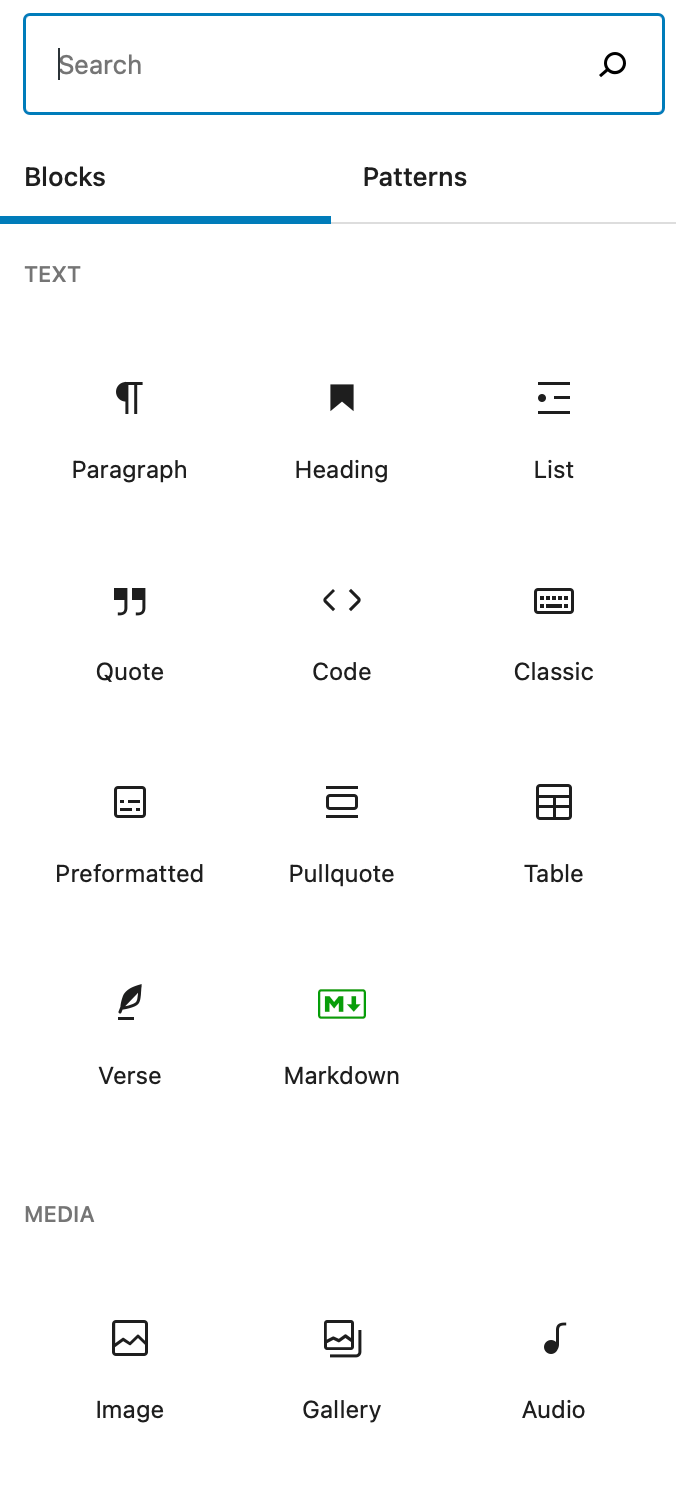
You’ve probably seen web editors based on the idea of blocks. I’m typing this in WordPress, which has a little + button that brings up a long list of potential blocks that you can insert into this page:
This kind of “insert block” user interface concept is showing up in almost every blogging tool, web editor, note-taking app, and content management system. People like it and it makes sense.
We have seem to have standardized on one thing: the / key to insert a new block. Everything else, though, is completely proprietary and non-standard.
I thought, wouldn’t it be cool if blocks were interchangeable and reusable across the web?
Until now, every app that wants blocks has to implement them from scratch. Want a calendar block? Some kind of fancy Kanban board? Something to embed image galleries? Code it up yourself, buddy.
As a result of the non-standardization of blocks, our end-users suffer. If someone is using my blog engine, they can only use those blocks that I had time to implement. Those blocks may be pretty basic or incomplete. Users might want to use a fancier block that they saw in WordPress or Medium or Notion, but my editor doesn’t have it. Blocks can’t be shared or moved around very easily, and our users are limited to the features and capabilities that we had time to re-implement.
To fix this, we’re going to create a protocol called the Block Protocol.
It’s open, free, non-proprietary, we want it to be everywhere on the web.
It’s just a protocol that embedding applications can use to embed blocks. Any block can be used in any embedding application if they all follow the protocol.
Our hope is that this will make life much easier for app developers to support a huge variety of block types. At the same time, anyone can develop a block once and have it work in any blog platform, note-taking app, or content management system. It is all 100% free, open, and any sample code we develop showing how to use the protocol will be open-source.
We’ve released a very early draft of the Block Protocol, and we’ve started building some very simple blocks and a simple editor that can host them.
We’re hoping to foster an open source community that creates a huge open source library of amazing blocks:
What can be a block?
If you work on any kind of editor—be it a blogging tool, a note-taking app, a content management system, or anything like that—you should allow your users to embed blocks that conform to the Block Protocol. This way you can write the embedding code once and immediately make your editor able to embed a rich variety of block types with no extra work on your part.
If you work on any kind of custom data type that might make sense to embed in web pages, you should support the Block Protocol. That way anybody with a hosting application that supports the protocol can embed your custom data type.
Because it’s all 100% open, we hope that the Block Protocol will become a web standard and commonly used across the Internet.
That will mean that common block types, from paragraphs and lists to images and videos, will get better and better. But it will also mean that some esoteric block types will be embeddable anywhere. Want to create a block that shows the Great Circle routing for a flight between two airports? Write the code for the block once and it can be embedded anywhere.
Oh, and one more thing. Blocks can be highly structured, that is, they can have types. That means that they magically become machine-readable without screen scraping. For example, if you want to create an event block to represent an event on a calendar, you will be able to specify a schema that describes the event data type in a standard way. That way tools like calendars can instantly parse and understand web pages that contain your event block, reliably.
Over time, it will mean that anyone can easy publish complex, typed data sets on the web that are automatically machine-readable without extra work. (Have you ever seen one of those websites where there’s a link to “download the data set in .XLS format”? Yeah, say goodbye to that.)
We’re going public with this very early in the development process because we need a lot of help!
Everything we have so far is version 0.1. It’s simple and not very good yet and going to need some iteration before it has the hope of truly being a useful web protocol.
Th
本页为82搜索生成的网页快照,内容来自站内索引;演示数据的原文链接仅作示例。