网页
综合
更新时间 2026-11-13 19:09:57
How AI Literacy Shapes GenAI Use - NN/G
Introducing NN/G Membership | Access all self-paced courses for $249 per year | Join by Jan. 26, 2027 |
Find the training option that fits your learning style.
February 6, 2026 2026-02-06
In my career as a UX researcher (particularly in civic tech and digital inclusion), I’ve spent years observing how people use the internet. As AI changes how users search for, create, and communicate information in both personal and professional contexts, it’s becoming an essential new dimension of digital literacy — one that introduces new competencies.
Despite the hype, not everyone is using generative AI (genAI) tools, such as ChatGPT and Gemini. And, those who are using it aren’t all using it in the same way. People working in technology often take for granted a level of comfort or sophistication with AI that many users simply don’t have. (Remember, you are not your user!) Understanding how users with low AI literacy interact with generative AI (genAI) is critical in designing inclusive and supportive AI experiences.
As AI increasingly impacts how people search, create, and communicate information online, AI literacy is emerging as a critical new component of digital literacy.
Digital literacy is broadly defined as the ability to find, evaluate, create, and communicate information using digital technologies.
AI introduces new interaction paradigms that require new mental models — ones that don’t always align with users' past experiences with search engines or traditional software.
In our research, two distinct capabilities shaped people’s success when using genAI for information seeking.
These capabilities don’t always grow together. Prompt fluency often increases quickly with exposure, but output literacy may lag: some people learn to get polished and, what they believe to be, helpful answers without becoming better at judging accuracy or knowing when to verify outputs. That’s why AI literacy can’t be measured along a single continuum. It’s a multidimensional skill set shaped by how people prompt, how they evaluate, and how they choose to engage with AI.
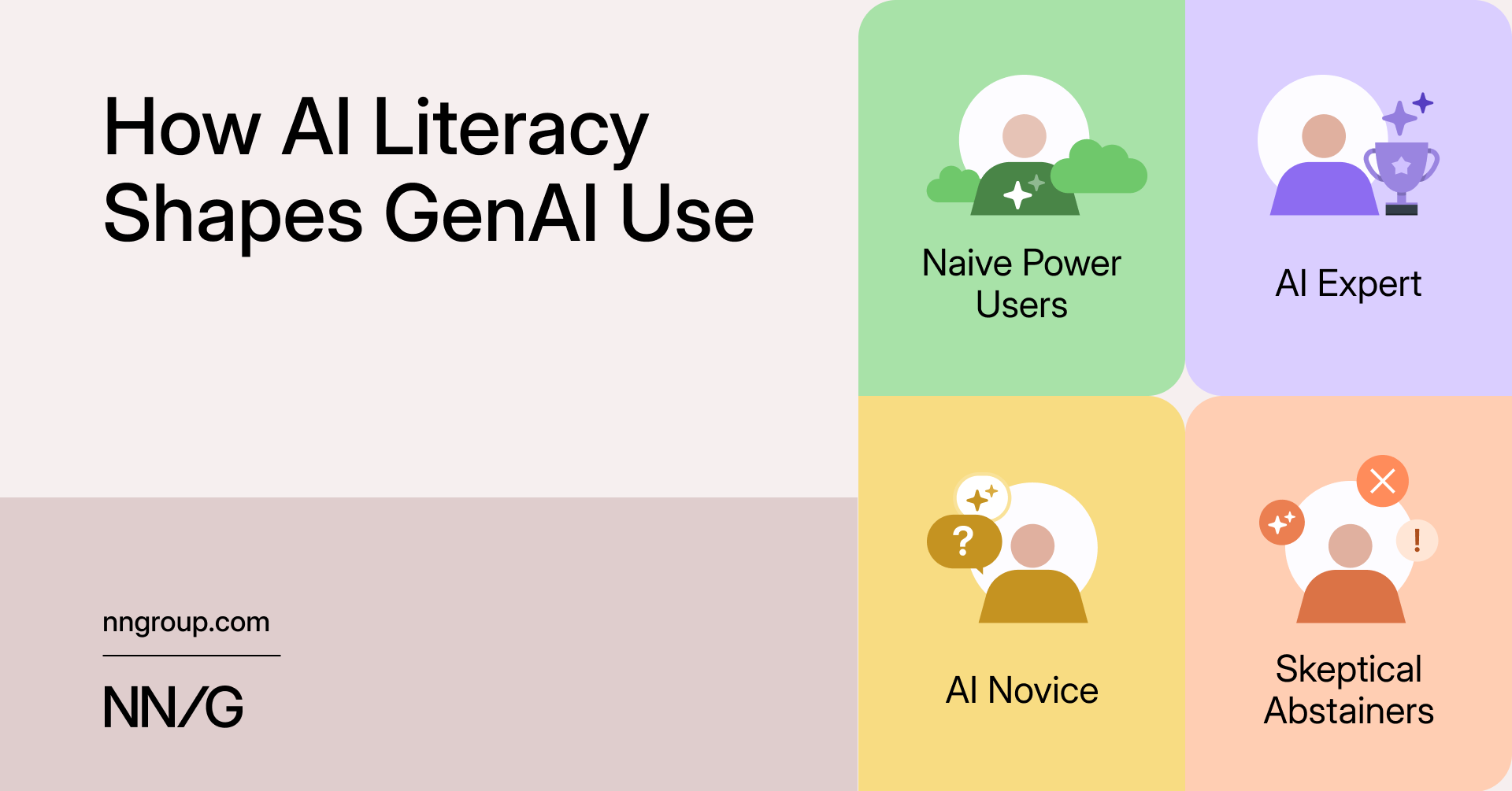
The matrix below highlights the types of AI literacy that we’ve observed in our research. Users can fall into one of four quadrants and can move over time into another quadrant based on their attitudes towards genAI, their exposure to it, or newly acquired AI knowledge.
These four quadrants aren’t just theoretical: we encountered examples of each user type in our recent study on information seeking with AI.
In this article, we show how prompt fluency and output literacy shape how people engage with genAI.
Designing AI Experiences teaches you how to design AI products that work for your users.
The best way to learn about digital literacy is not to ask, but to watch.
In a recent study, we watched participants aged 23 to 65 conduct research using both the traditional web and genAI on tasks of their own choice. They were free to use any sites or tools and were unaware that the study focused on AI. If they didn’t use AI initially, we encouraged them to try it later in the session. Participants researched a variety of topics, including vacation destinations, DIY projects, and major purchases. Study participants had varying AI experience: one was new to genAI chatbots, three used AI only for specific work tasks, and five used genAI regularly in both personal and professional settings.
To recap, prompt fluency refers to the user’s ability to communicate intent, constraints, and context so that genAI can produce useful outputs.
When writing prompts, prompt-fluent participants explained what they were trying to accomplish and what mattered to them. They included context for their problem and constraints for the expected solution. As a result, their prompts were, on average, longer. As one participant said, while composing a longer prompt, “I’m just trying to provide some context here. It seems like it often improves the results a little bit.”
Example prompt: I want to go Montauk, Long Island in New York. I think the Kirk Park Beach is one of the best spots around, given that it is near the downtown area. Do you have a better recommendation? And which cafe/restaurants are the best in the area?
Participants with low prompt fluency were less likely to include context or constraints. Their prompts often resembled search queries, possibly because they conflated genAI with a search engine.
Example keyword-style prompt: smart refrigerator with bottom freezer
In addition, prompt-fluent participants often made more complex requests, asking multiple questions at once and requesting formats that supported decision making (such as tables or ranked lists).
To illustrate this difference, the following are two prompts from participants with very different levels of prompt fluency. They both used genAI to narrow down on a car model to buy.
Which car or suv pick based one hour commute camry xse or crv sports l hybrid
This difference was typical throughout the study. Prompt-fluent participants were more likely to continue within the same conversation and build on prior context. They often generated followup prompts that added context without asking explicit questions, expecting genAI chatbots to incorporate earlier context.
Example followup prompts
When I go to Kindle eBooks looking for "free kindle store picks" I don't see a top 100 Free page.
You're making good points, but I had really wanted to use these A19 Philips hue bulbs that I already have for the job.
We are likely going to want to be west of the Mississipi [sic] River so anything west of that is good
One expert user had several conversations pinned in their Gemini account and told the facilitator:
“I might go back to a previous conversation if I want it to remember everything that I discussed previously.”
In contrast, some novices restarted conversations unnecessarily. One participant repeatedly used the browser’s Back button to start fresh each time she refined her question, rather than continuing in the same conv
本页为82搜索生成的网页快照,内容来自站内索引;演示数据的原文链接仅作示例。