网页
综合
更新时间 2026-11-13 19:05:15
The Return of the UX Generalist - NN/G
Introducing NN/G Membership | Access all self-paced courses for $249 per year | Join by Jan. 26, 2027 |
Find the training option that fits your learning style.
March 28, 2025 2025-03-28
For years, our industry has debated (and sometimes derided) the concept of the "UX unicorn,” that mythical professional who can do it all: qualitative research, quantitative research, design, content strategy, and more. Over the past decade, we've concluded that specialization is more practical, especially as larger design organizations and focused roles became the norm. As AI reshapes our field, we're seeing an interesting shift: the return of the generalist.
In the past decade or two, UX has been highly specialized in large organizations with higher UX maturity. These organizations have typically employed:
This specialization makes sense — each area requires deep expertise and specific tools, and in large organizations, there’s been a high enough volume of work to justify employing a separate role. When structured correctly, these separate roles collaborate, bringing their specialized skills together to create well-rounded, vetted solutions.
AI is already shifting this dynamic. AI tools and capabilities are starting to fill skill gaps, assisting in specialized tasks that once required years of expertise to master.
For example, a visual designer can now leverage AI to generate various options for interface copy. A researcher can get AI advice on an accessible color palette or explore different data visualizations.
This democratization of expertise is happening gradually across both UX tools and roles. Increasingly, individuals can accomplish tasks that previously required collaboration with several experts in different areas. As genAI technology becomes more reliable and better integrated into UX work, this trend will accelerate.
This trend won’t end professions altogether, though. While AI increasingly complements human abilities, current large language models (LLMs) still require careful human oversight due to hallucinations and context drifting. Trained professionals will be necessary to catch errors, align AI outputs with real-world constraints, and coordinate across teams.
The rise of AI tools doesn't mean becoming a "unicorn" who can do everything perfectly. Specialization will remain valuable in our field: there will still be dedicated researchers, content strategists, and designers.
NN/G’s Self-Paced Courses offer in-depth, research-backed training to make you an expert in whatever skill you’re expanding.
However, AI is broadening the scope of what any individual can accomplish, regardless of their specific expertise.
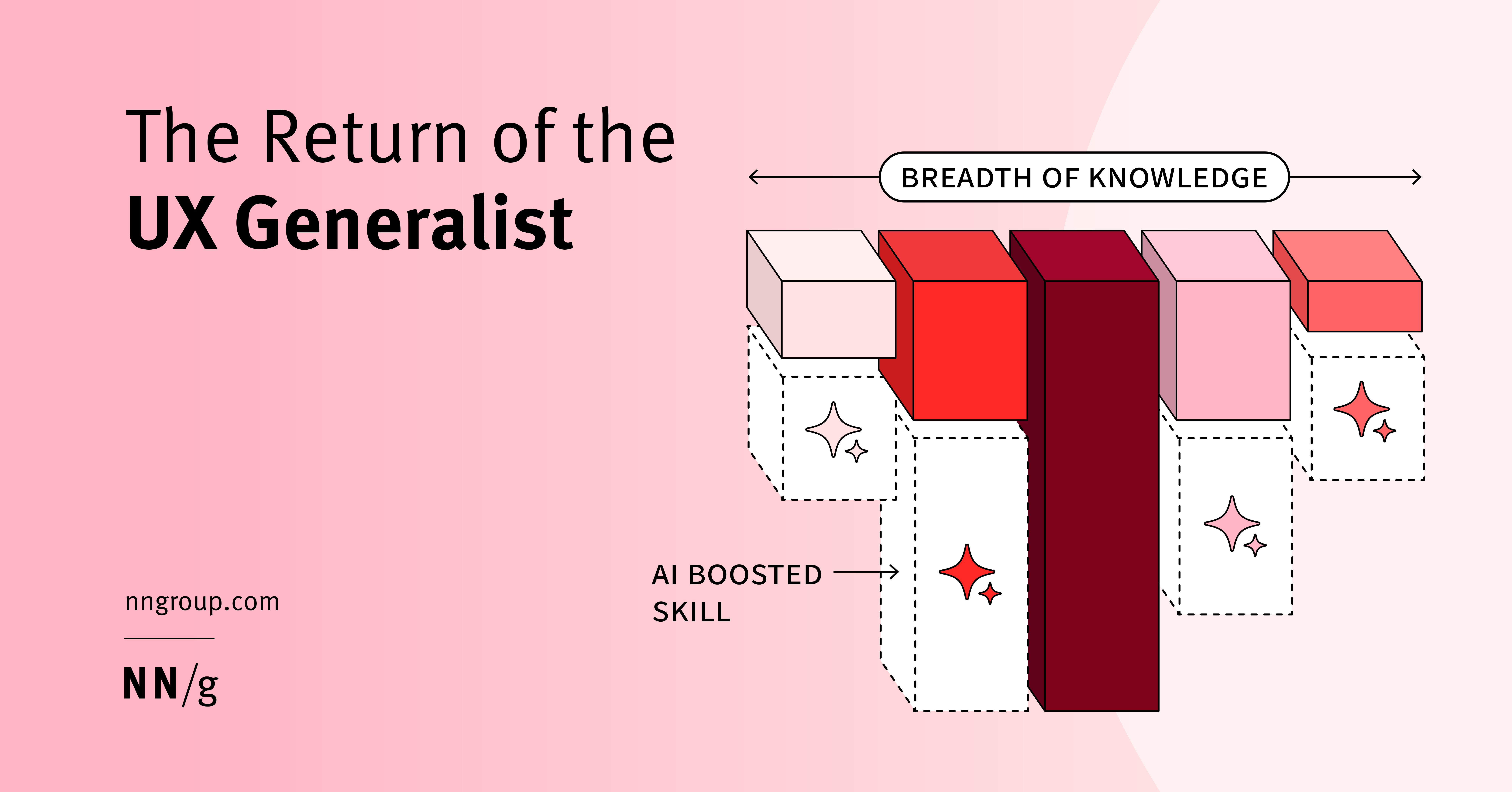
What we're seeing isn't the elimination of specialization but rather an increased value placed on expanding the top of a professional's "expertise T.”
Notice that the expertise T will also become shallower, as going really deep within a specialization will not benefit most people. Deep mastery will be the domain of academics investigating new knowledge or techniques, or large institutions addressing complex problems.
We believe these broad skills will coalesce into experience designer and architect roles: people who direct AI-supported design tasks to craft experiences for humans and AI agents alike, while ensuring that the resulting work reflects well-researched, strategic thinking.
These generalist roles will not achieve perfection, or even the lofty heights of a well-trained specialist. Specialists will maintain advantages with lesser-known or advanced techniques. They will also be needed in mission-critical situations, where their expertise will help catch "invisible" problems that a generalist might overlook.
However, economic pressures will favor staffing strategies that are "cheap, fast, and good enough", despite the drawbacks. UX design is not like medicine or civil engineering. This broader generalist approach to design will rarely result in catastrophic outcomes. Therefore, companies will increasingly rely on AI-augmented generalists due to the strong business case for their efficiency, adaptability, and sufficient results.
We already see this trend emerging at leading AI companies. Anthropic, for instance, recently advertised a "design engineer" position that explicitly combines product management, design, and development responsibilities. This hybrid role requires professionals who can think across traditionally separate domains to create cohesive AI experiences.
This evolution reminds us of how the role of front-end developer (FED) emerged 15 years ago as a bridge between specialized backend development and design teams. What initially seemed like an unusual hybrid eventually became an industry standard, as the complexities of web interfaces demanded professionals who could navigate both technical and design considerations. Similarly, these new AI-focused generalist roles may begin as exceptions but could quickly become essential as organizations adapt to AI-driven design processes.
A UX generalist isn't simply someone who dabbles in multiple disciplines. True generalist thinking involves a fundamentally different approach to understanding and solving problems. These professionals excel at recognizing patterns that span different areas of expertise and can often spot solutions that specialists might miss.
For example, a UX researcher working to become a UX generalist might:
This crosspollination of ideas leads to innovative solutions that transcend traditional disciplinary boundaries.
This approach isn't entirely new — many veterans who entered the field 20+ years ago started as generalists out of necessity. In the early days of UX, professionals often wore multiple hats by default, handling everything — from research to design to usability testing. These seasoned practitioners have long understood the value of crossdisciplinary thinking.
However, for those who joined the industry during the past decade (a period of increasing specialization and role definition), this s
本页为82搜索生成的网页快照,内容来自站内索引;演示数据的原文链接仅作示例。