网页
综合
更新时间 2026-11-13 19:04:52
User Need Statements - NN/G
Find the training option that fits your learning style.
March 24, 2019 · Last reviewed Sep. 2, 2026 2026-09-02
In design thinking (as well as in any product-development process), it is important to define the problem you want to solve before spending time and resources on generating possible solutions. (A great solution to the wrong problem will fail.) This approach maximizes resource use and decreases the likelihood for friction and disagreement in the prototyping, testing, and implementation stages.
User need statements, also often called problem statements or point-of-view statements, are the primary tool in the second stage of design thinking — the define stage; they align different points of view before moving forward into ideating. It doesn’t matter which term you choose to use (user need, problem, or point of view)— it only matters that you remain consistent throughout your organization.
User need statement: An actionable problem statement used to summarize who a particular user is, the user’s need, and why the need is important to that user. It defines what you want to solve before you move on to generating potential solutions, in order to 1) condense your perspective on the problem, and 2) provide a metric for success to be used throughout the design thinking process.
Most importantly, the purpose of user need statements is to capture what we want to achieve with our design, not how. They help advance our presumptive solutions from specific features (such as a button or other UI implementation) towards deep insights about the problem that the user needs to solve. Simplistically, user need statements encourage us to see users’ needs as verbs (that is, goals and end states) instead of nouns that describe solutions. For example, users don’t ever need a dropdown (noun); they need to see the choices that they can make and select one of them (verb). They don’t need a dashboard (noun) — they need to digest varied information in one place (verb). The nouns are possible solutions to users’ needs, but they are not the only solutions. If we focus on these nouns, we run the risk of ending up with suboptimal designs. The entire purpose of ideation is to explore ideas, so don’t lock yourself down prematurely by selecting the solution too early.
Our live online course, Design Thinking Essentials, teaches you the steps you need to design high-quality solutions.
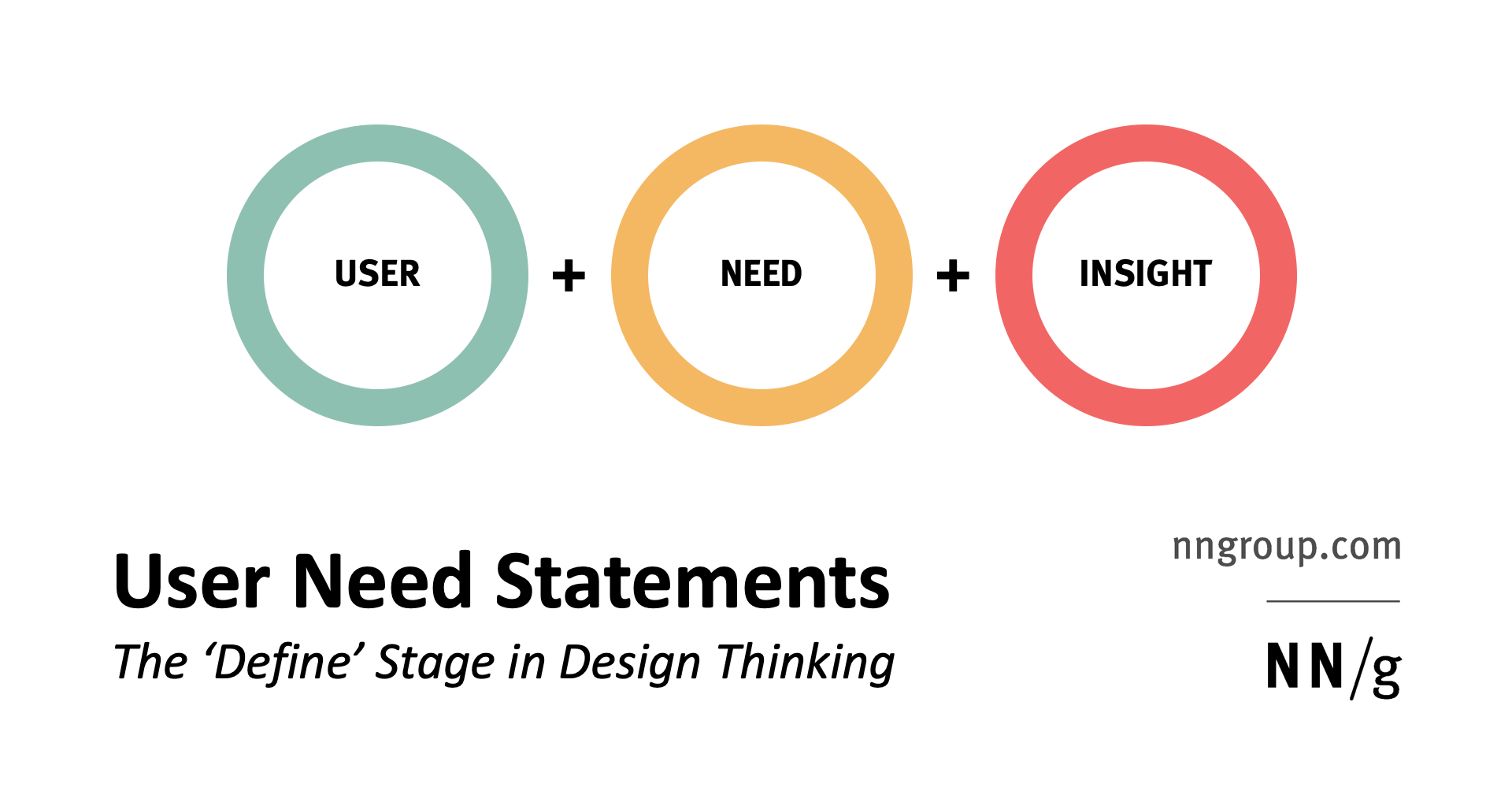
Traditional need statements have 3 components: 1) a user, 2) a need, and 3) a goal. These are then combined following the pattern [A user] needs [need] in order to accomplish [goal].
For example, [Alieda, a multitasking, tech-savvy mother of 2] needs [to quickly and confidently compare options without leaving her comfort zone] in order to [spend more time doing the things that really matter].
The user should correspond to a specific persona or real end-user segment you’ve done research on. It is helpful to include a short tagline that helps remind everyone who the user is, especially if the need statement will be used by a large team or by stakeholders who are removed from research:
The need should be real, should belong to users, should not be made up by the team, and should not be phrased as a solution. Stay away from features, interface components, and specific technology. For example, possible goals may be:
Keep in mind: users do not always know what they need, even though they may say so. A famous quote, attributed to Henry Ford, says, “If I asked people what they wanted, they would have said faster horses.” It is your job to understand the real need of your user.
The insight, or goal, is the result of meeting that need. It should be rooted in empathy. Look beyond the obvious — what will this solution allow the user to accomplish? For example, think about the user’s hopes, fears, and motivations:
The cognitive and collaborative process of making a user need statement and the finished statement itself have important benefits for your team and your organization:
A need statement distills your knowledge of the users and their need into a single sentence. It is especially helpful in condensing research insights (survey answers, user-interview transcripts, empathy maps) before looking for solutions — thus increasing clarity and allocation of time.
A user need statement is a concise, articulate way of communicating your user and their need across multiple team members and stakeholders. Once created, it should act as a guiding force — alignment throughout a project of what you and your team seek to solve.
User need statements, if properly crafted, have the added benefit of providing a metric for success prior to the onset of ideation, prototyping, and testing. Use the insight, or goal, and ask yourself: how will we know if we accomplish this? Then, as you create your needs statements, establish corresponding metrics for success. This approach will decrease friction down the road and set a clear bar for your team or organization.
User need statements can be applied to varying scopes. It is likely you will have multiple need statements within one project: an overarching, umbrella statement and subordinate need statements that articulate smaller goals for that user type. You should scope your need statements based on your current project needs.
Start by creating an ‘umbrella’ or ‘parent’ (broadly scoped) need statement when your goal is to:
A ‘parent’ need statement will likely have a broad goal that will overarch each component of the project. For example, the need statement from above could be regarded as a parent goal:
[Alieda, a multitasking, tech-savvy mother of 2] needs [to quickly and confidently compare options without leaving her comfort zone] in order to [spend more time doing the things that really matter].
Conversely, it is beneficial to start with a ‘child’ (small-scope) need statement if your goal is to:
A ‘child’ need statement will have a specific need and a goal that can be satisfied in 1-2 releases:
[Alieda, a mult
本页为82搜索生成的网页快照,内容来自站内索引;演示数据的原文链接仅作示例。