网页
综合
更新时间 2026-11-13 16:47:05
Download Django | Django
The web framework for perfectionists with deadlines.
Django is available open-source under the BSD license. We recommend using the latest version of Python. See the FAQ for the Python versions supported by each version of Django. Here’s how to get it:
The latest official version is 6.1.3. Read the 6.1.3 release notes, then install it with pip:
The latest and greatest Django version is the one that’s in our Git repository (our revision-control system). This is only for experienced users who want to try incoming changes and help identify bugs before an official release. Get it using this shell command, which requires Git:
git clone https://github.com/django/django.git
You can also download a gzipped tarball of the development version. This archive is updated every time we commit code.
See the installation guide for further instructions. Make sure you read the documentation that corresponds to the version of Django you’ve just installed.
And be sure to sign up to the Django Forum, where other Django users and the Django developers themselves all hang out to help each other.
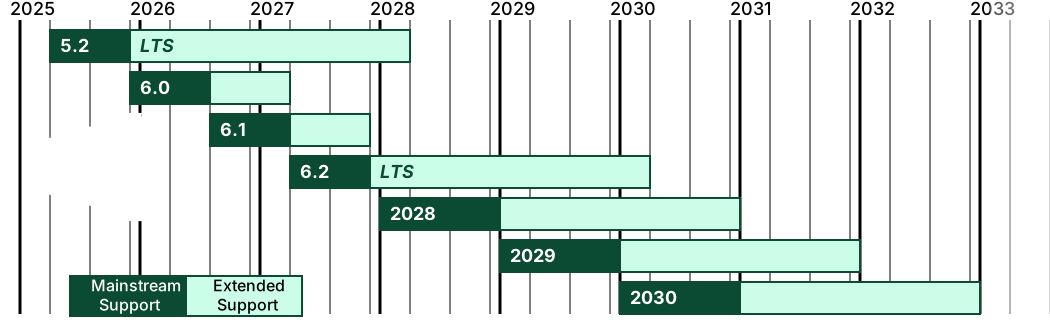
Feature releases contain new features, improvements to existing features, and other enhancements. Beginning with Django 2028, feature releases will use the version format YYYY and will be released every January. Earlier feature releases used the version format A.B and were released roughly every eight months.
Patch releases (for example, 6.1.2 or 2028.3) are issued as needed, to fix bugs and/or security issues. These releases are 100% compatible with the associated feature release, unless this is impossible for security reasons or to prevent data loss. So the answer to "should I upgrade to the latest patch release?” will always be "yes."
Django 6.2 is the final release under the previous versioning and support policy. Under that policy, only designated long-term support (LTS) releases received the full three-year support period. Starting with Django 2028, every feature release receives the same three-year support period. Refer to the tables below for the support periods.
See the supported versions policy for detailed guidelines about what fixes will be backported.
These release series no longer receive security updates or bug fixes.
[1] Security fixes, data loss bugs, crashing bugs, major functionality bugs in newly-introduced features, and regressions from older versions of Django. [2] Security fixes and data loss bugs. [3] Last version to support Python 2.7.
We improve Django almost every day and are pretty good about keeping the code stable. Thus, using the latest development code is a safe and easy way to get access to new features as they’re added. If you choose to follow the development version, keep in mind that there will occasionally be backwards-incompatible changes. You’ll want to pay close attention to the commits by watching Django on GitHub or subscribing to django-updates.
If you’re just looking for a stable deployment target and don’t mind waiting for the next release, you’ll want to stick with the latest official release (which will always include detailed notes on any changes you’ll need to make while upgrading).
© 2005-2026 Django Software Foundation and individual contributors. Django is a registered trademark of the Django Software Foundation.
本页为82搜索生成的网页快照,内容来自站内索引;演示数据的原文链接仅作示例。