网页
综合
更新时间 2026-04-06 00:00:00
Battery Parameter Estimation for R&D Teams | Ionworks | Ionworks
A solver can run in seconds. Assembling a defensible parameter set often takes weeks. A practical guide to battery parameter estimation across ECM, SPM/SPMe, and DFN models, with the data each one actually needs.
Battery parameter estimation is the work that sits between raw test data and a simulation you can trust. Every battery model needs a parameter set, and the quality of that set decides whether a simulation informs an engineering decision or misleads one. For most R&D teams, building and validating parameter sets is the slowest and least repeatable step in the modeling workflow.
A cycling test produces voltage, current, and temperature traces. A physics-based simulation requires dozens of transport, kinetic, geometric, and thermodynamic inputs. Parameter estimation is the gap between those two states.
The difficulty scales with model fidelity. An equivalent circuit model (ECM) might need a handful of resistance and capacitance values fitted to pulse data. A full electrochemical model, like the Doyle-Fuller-Newman (DFN) formulation, can require 35 or more parameters drawn from teardown, half-cell, impedance, and pulse experiments, as demonstrated by Chen et al. 2020 for a commercial 21700 cell.
A solver can run in seconds. Assembling a defensible parameter set often takes weeks. That asymmetry is where teams lose time, introduce error, and break reproducibility.
The data burden for battery model parameterization depends on the model class. Framing estimation around three tiers helps teams plan test campaigns and set expectations for what a given model can and cannot resolve.
Equivalent circuit models represent cell behavior with resistors, capacitors, and voltage sources. The canonical first-order Thévenin form uses a state-of-charge dependent open-circuit voltage in series with an ohmic resistance and one or more RC pairs.
ECMs are purely empirical. They are fitted directly to full-cell current and voltage data and do not simulate any internal electrochemical process. Their strengths are speed, simplicity, and compatibility with BMS environments where state estimation and real-time control matter more than internal physics. The tradeoff is that fitted parameters carry limited physical meaning, predictive accuracy is bounded by interpolation inside the training data, and the model cannot distinguish between positive and negative electrode behavior.
ECM fitting needs time-series current and voltage data from operating conditions that match the intended application window. A pulse discharge at 25°C will not produce a parameter set that works for fast charge at 0°C.
Lumped physics-based models capture intercalation kinetics and solid-phase diffusion in each electrode, but simplify the spatial variation across the cell by assuming uniformity through the electrode thickness. The Single Particle Model (SPM) represents each electrode as a single representative particle. The SPMe variant adds electrolyte dynamics on top of that reduction.
Lumped physics-based models sit between ECMs and full physics. They simulate electrode-specific state of charge, overpotentials, and internal heat generation without requiring full teardown data. That makes them useful for diagnosing cell imbalances or degradation precursors when a DFN campaign is out of budget. The limitations are real: they rely on fitted OCV curves for each electrode, they cannot resolve electrolyte gradients or electrode heterogeneity, and they can miss local effects like lithium plating or electrolyte depletion.
The key thing to understand about "lumped" parameterization is what it does and does not resolve. Lumping does not mean fitting fewer individual parameters. It means fitting the dimensionless or dimensional groups that the full-cell response is actually sensitive to, instead of trying to recover each underlying physical quantity separately. Full-cell voltage and current data cannot tell you the particle radius R and the solid-phase diffusivity D independently, because they only enter the cell-level response through the diffusion timescale τ = R²/D. In the same way, electrode area A, coating thickness L, active material volume fraction ε, and maximum lithium concentration c_max are not separately identifiable from full-cell cycling — only the lumped electrode capacity Q = A·L·F·ε·c_max/3600 (in Ah) shows up in the data. A lumped parameterization fits τ and Q directly and stops there. That is why teardown is not required: the model is honest about what the experiment can resolve.
SPM and SPMe parameterization typically needs full-cell OCV data, rate capability tests across multiple C-rates, and HPPC or pulse data for the lumped diffusion timescales and reaction rate groups. SPMe parameterization adds an analogous lumped treatment of electrolyte transport and usually requires richer fitting but remains tractable from standard full-cell experiments.
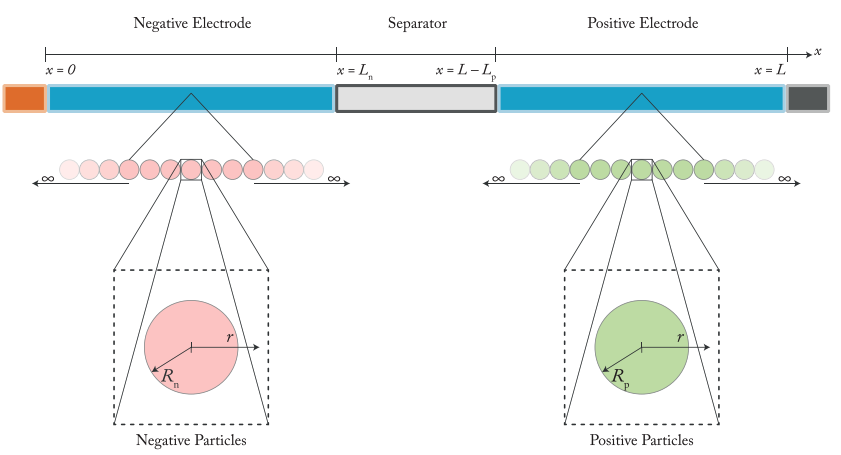
Full physics-based models solve coupled partial differential equations for conservation of mass, charge, and energy across both electrodes, the separator, and the electrolyte. The DFN (pseudo-2D) formulation resolves solid-phase diffusion, electrolyte transport, and reaction kinetics across the cell thickness.
These models provide the highest fidelity available for cell-level simulation. They can capture spatial heterogeneity, electrolyte depletion, overpotential distributions, and the precursors to failure modes like lithium plating at high rate or low temperature. They are also the natural home for degradation mechanism modeling, where SEI growth, particle cracking, and loss of active material couple back into the electrochemistry.
The cost is parameter intensity. DFN parameter estimation requires teardown measurements, half-cell experiments, stoichiometric window identification, kinetic and diffusion parameters, and thermal characterization. Chen et al. 2020 documented an experimental workflow that includes GITT, EIS, three-electrode full-cell configurations, and current-pulse anal
本页为82搜索生成的网页快照,内容来自站内索引;演示数据的原文链接仅作示例。