网页
综合
更新时间 2026-05-15 00:00:00
Material properties aren't cell metrics | Ionworks | Ionworks
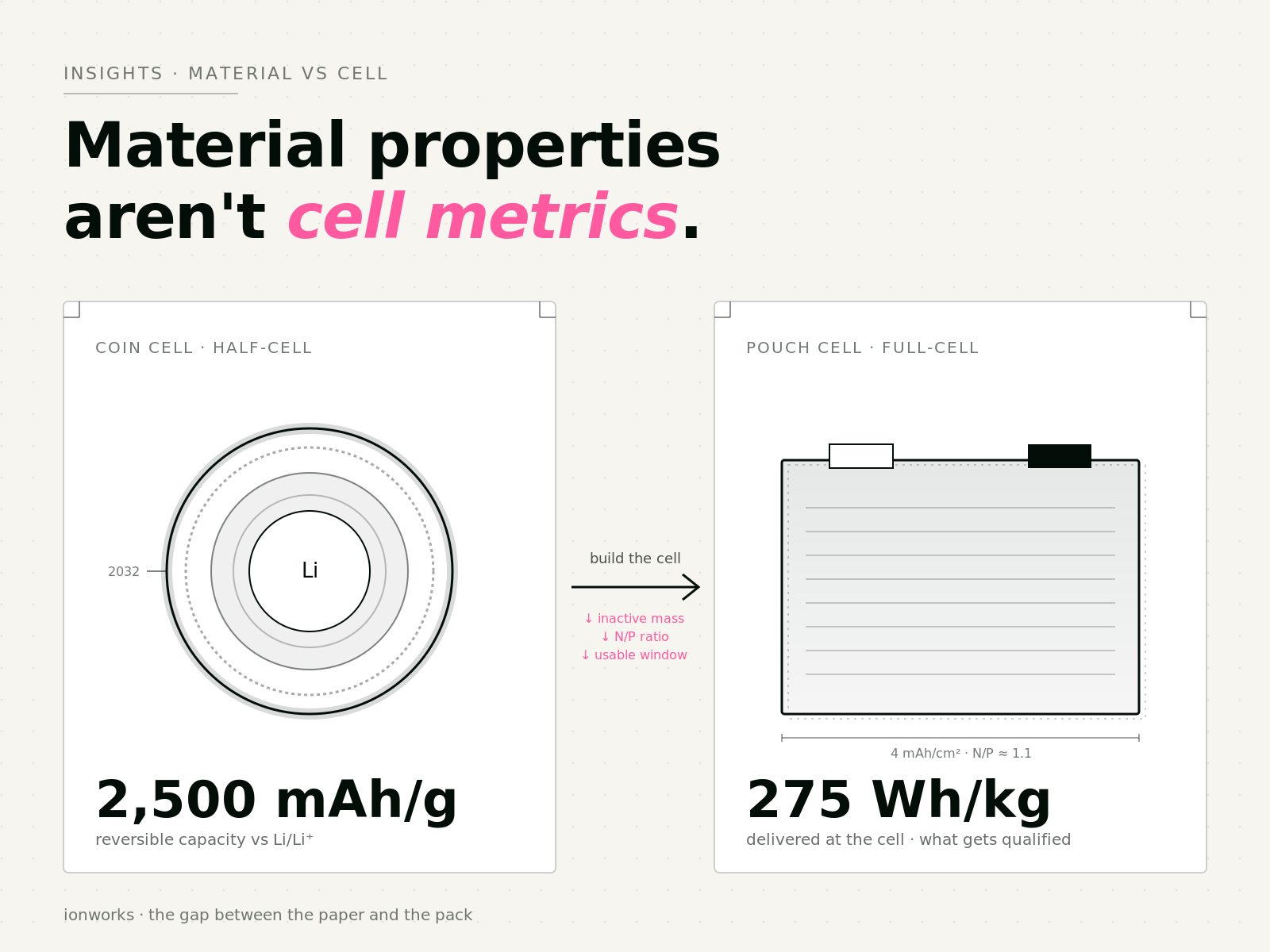
A material can look excellent in a coin cell and still leave a finished cell short on energy density, charge rate, or lifetime. The gap between material-level results and cell-level performance is where most of the engineering work actually lives.
A new electrode material shows a reversible capacity of 2,500 mAh/g in a coin cell against a lithium-metal counter electrode. The cycling curves look clean. A press release goes out. Two years later, the same material is in a commercial pouch cell, and that cell delivers less energy per kilogram than the high-nickel NMC it was supposed to replace. The active material did exactly what the half-cell data promised. The cell did not.
This gap between material-level performance and cell-level performance is one of the most persistent sources of disappointment in battery R&D. It is also the place where most of the engineering value gets created or destroyed. A 2023 Nature Communications perspective by Ulissi makes the case bluntly: the metrics that get a paper published (specific capacity at the electrode level, cycle life of a thin coupon, conductivity of a freshly pressed pellet) are not the metrics that get a cell qualified. Cao and Amine had argued the same point a few years earlier in Nature Nanotechnology, calling explicitly for the field to align the academic and industrial metrics used to report progress on new battery chemistries. Translating between them is a non-trivial engineering problem in its own right.
Lab-scale coin cells (the 2032 format and its relatives) are designed for screening, not for representativeness. The Ulissi perspective puts numbers to the gap. A typical lab coin cell uses several times the practical loading of electrolyte and a large excess of lithium metal as the counter electrode. The N/P ratio (the ratio of negative-to-positive capacity) is effectively infinite. Coating thicknesses are often a fraction of what a commercial cell uses. Porosities are higher than what you'd ever ship.
Every one of those choices masks a real-world constraint:
The Ulissi paper makes the point that a "fast-charging" material in a coin cell may have been tested at conditions that bear no resemblance to a commercial fast charge. The same is true for cycle life: thousands of cycles at low rate, low areal capacity, and unlimited lithium say very little about a 4 mAh/cm² electrode being cycled 1C/1C in a pack. Nölle and colleagues spelled this out in detail in Materials Today, walking through how the cell setup itself determines what conclusions can honestly be drawn from a given electrochemical measurement. Liu and colleagues made it quantitative in Nature Energy: getting a lithium-metal cell past 350 Wh/kg requires controlling cathode loading, electrolyte amount, and Li foil thickness simultaneously, each of which is invisible in a typical half-cell test.
The same paper shows the cost of moving from theoretical material performance to a useful battery in stark terms. For a current high-energy NCA cell with a silicon-containing graphite negative electrode, the theoretical specific energy of the active materials is roughly halved by the time you reach a usable pack. The graphite||LFP system loses a smaller fraction, but starts from a lower theoretical number. Schmuch and colleagues laid out the same accounting for automotive cells in Nature Energy, tracing how the price-per-kWh and the energy density delivered at the pack are both shaped by choices that look like cell-engineering trivia at the material stage: binder fraction, electrode loading, format selection, and pack architecture.
The losses come from places that are invisible at the material level:
A material that looks 30% better than incumbent on a per-gram basis may give you 10% at the cell and 3% at the pack. It may give you nothing at all if the gains came from a chemistry window that can't be cycled, or if realizing them requires a pack architecture Li-ion has never needed. Li-metal anodes are the obvious example: they depend on sustained uniform stack pressure across the cell face (typically a few MPa) to keep plating smooth and avoid dendrites, which means platens and clamping hardware that add mass and volume no Li-ion pack ever had to budget for. The decision about whether to develop it cannot be made from the material data alone.
Silicon negative electrodes. Pure silicon stores around 3,580 mAh/g of reversible capacity, roughly ten times graphite. In a half-cell, that capacity comes out cleanly. In a full cell, two things have to be managed. The first is volumetric expansion of roughly 280% on full lithiation, which fractures particles and the SEI and consumes lithium and electrolyte every cycle. The second is the N/P balancing problem: silicon's swing in stoichiometry forces tight balancing to keep the cell within its voltage limits. Eshetu and colleagues gave a thorough industrial-perspective review of what it actually takes to build a working silicon-containing high-energy cell. Different programs land in different places. Silicon-oxide blended into graphite, high-silicon composites with engineered binders, and high-Si or pure-Si anodes with mechanical accommodation and prelithiation are all shipping in some form today. Each path represents a multi-year cell-engineering effort wrapped around the same active material. The material specs of pure silicon have been known for decades. The cell-level engineering is what took the time.
High-nickel and high-capacity cathodes. The center of gravity has moved from NMC811 to NMC9-series and to Li- and manganese-rich (LMR) chemistries, both of which push the same envelope harder: more capacity per gram, higher voltage windows, higher demands on the electrolyte and the anode. The reason commercial cells using these cathodes still charge to a lower upper cutoff than the active material can theoretically handle is not the cathode in isolation. It is the combination of cathode surface reactivity, electrolyte oxidation, and gas generation t
本页为82搜索生成的网页快照,内容来自站内索引;演示数据的原文链接仅作示例。