网页
综合
更新时间 2026-11-15 00:05:29
About Ionworks: physics + AI for battery R&D | Ionworks
We built PyBaMM, the most widely-used open-source battery modeling library, and spent a decade making physics-based simulation fast enough to live inside real R&D decisions.
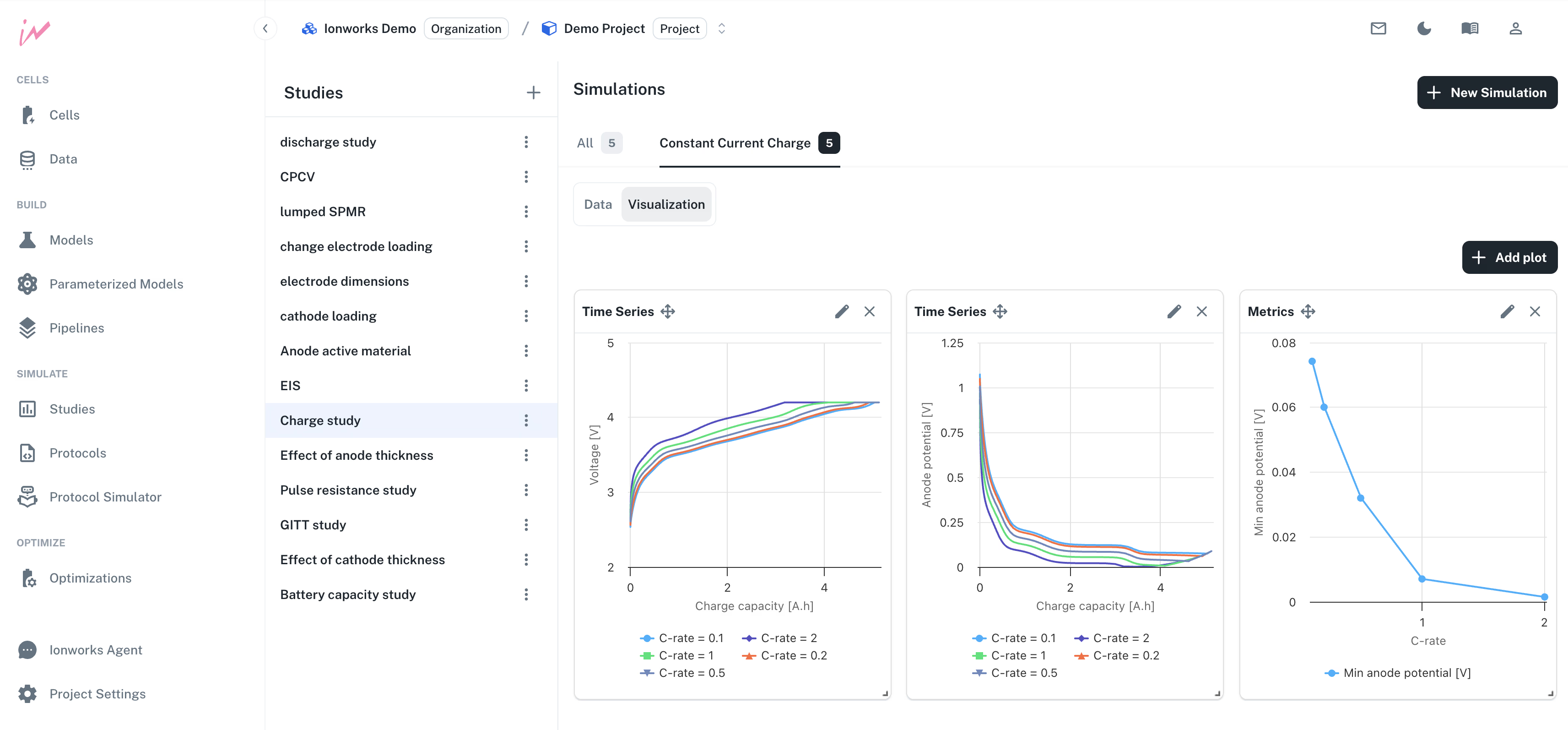
Ionworks is the layer on top: the Battery Simulation OS that turns cycler data into validated models, generates the labelled datasets ML methods need, and exposes electrochemical physics as something agents and optimization loops can actually call. The right architecture is physics + AI, not physics or AI.
Co-created PyBaMM as a PhD student at Oxford in 2018. Postdoc work at Michigan and Carnegie Mellon focused on fast electrochemical models and hybrid physics + data methods for battery lifetime prediction.
PhD applied maths, Oxford · Postdoc Michigan, CMU · PyBaMM co-creator
Core PyBaMM developer since 2018. At Oxford’s Mathematical Institute he led the work on reduced-order 3D thermal and mechanical models for lithium-ion cells inside the Faraday Institution’s Multi-Scale Modelling project.
PhD maths, UEA · Postdoc Oxford Math Inst · Faraday Institution
Founding Commercial Lead
Nearly two decades in battery and energy software. Previously Director of Validation at Northvolt and Senior Director of Sales and Solutions Engineering at Voltaiq, where he ran customer deployments of battery analytics across cell makers and OEMs.
ex-Northvolt · ex-Voltaiq · 20 yrs battery + enterprise software
Founding Algorithms Engineer
Came from the Braatz group at MIT, where his PhD covered high-performance simulation of physics-based battery models, optimal charging algorithms, and parameter identifiability. Author of PETLION, the Julia P2D simulator.
PhD ChemE, MIT (Braatz) · ex-JuliaHub, NREL · author of PETLION
Founding Battery Simulation Engineer
Joined from Carnegie Mellon and the Viswanathan group, where his research covered lithium-ion degradation (including knee-point analysis of aging trajectories) and battery models for electric aircraft and EVs.
Carnegie Mellon (Viswanathan group) · EV + electric aviation modeling
Founding Computational Engineer
Lead developer of PyBOP, the open-source parameter optimisation library for PyBaMM and equivalent-circuit models. PhD on physics-informed models for lithium-ion batteries; postdoc at Oxford’s Department of Engineering Science.
PhD, Oxford Brookes · Postdoc Oxford Eng · PyBOP lead
Founding Systems Engineer
Owns the systems infrastructure behind Ionworks Studio: simulation orchestration, parallel compute, and the data plane that backs every study.
Systems + infra engineering · simulation orchestration
Battery and ML pioneer. Associate Professor at the University of Michigan with joint appointments across Aerospace, Mechanical, and Materials Science. His group pairs automated experimentation with machine learning, including the Clio and Dragonfly system that discovered fast-charging electrolytes.
Assoc Prof, Michigan · NSF CAREER · Sloan Fellow · battery + ML
Ferran Brosa-Planella
Associate Professor at the University of Warwick and PyBaMM core developer. Leads the Mathematical Modelling for Sustainability Group; works on derivation, reduction, and parameterisation of physics-based battery models.
Assoc Prof, Warwick · PyBaMM maintainer · Faraday Institution
Director of GM’s Chemical Sciences and Materials Systems Laboratory, where he has shaped automotive battery and materials research since 1986. Fellow of the Electrochemical Society and member of the National Academy of Engineering.
Director, GM R&D · NAE · ECS Fellow · 13k+ citations
At R&D scale, datasets are small. A single ML model rarely generalizes across cell formats, chemistries, and duty cycles. Conservation of mass and charge constrain where lithium can go, and those constraints are too powerful to discard. Ionworks is built on the working assumption that the right architecture is physics with AI on top: calibrated, queryable, reproducible.
PyBaMM is the most widely-used open-source battery physics engine. Ionworks turns it into a parameterized, callable service: the same Doyle-Fuller-Newman, SPMe, and SPM models, reachable from notebooks, agents, and optimization loops without rebuilding the stack each time.
Surrogate models and ML lifetime predictors are only as good as the data underneath. Our protocol-driven simulations generate physically consistent datasets across temperature, C-rate, and chemistry, labelled with the parameter sets that produced them.
At the R&D stage, datasets are small and conservation laws still bind. We pair validated electrochemical models with data-driven layers (degradation residuals, parameter drift, formation effects) so the AI part fills the gaps the physics can’t close.
PyBaMM is the most popular open-source battery modeling library, used in companies and universities around the world. It is the substrate that the Simulation OS, and an increasing number of AI-for-batteries projects, run on.
Whether you’re evaluating Ionworks Studio, generating training data for a battery ML project, or scoping a consulting engagement, you’ll work with the team that wrote the models from day one.
The battery data and simulation layer.
Built by the creators of PyBaMM
© 2026 Ionworks Technologies Inc.
本页为82搜索生成的网页快照,内容来自站内索引;演示数据的原文链接仅作示例。