网页
综合
更新时间 2026-11-13 14:01:47
Just Because You Can, Doesn't Mean You Should: Re-evaluating Galera Node Weights - Percona
Enterprise-ready open source PostgreSQL
Percona Software for PostgreSQL
Open source PostgreSQL software for production workloads
Model infrastructure requirements for PostgreSQL deployments.
Download PostgreSQL software and tools
Enterprise Support and Services
Expert help to run PostgreSQL in production
Open source MySQL for enterprise use
Percona Software for MySQL
Production-ready open source MySQL software
Compare DBaaS vs MySQL on Kubernetes cloud costs
Download MySQL software and tools
Enterprise Support and Services
Expert help to run MySQL in production
Enterprise-grade value for MongoDB®
Percona Software for MongoDB®
Source-available, enterprise-grade compatible software for MongoDB®
Compare MongoDB® deployment options, costs, and trade-offs.
Download MongoDB® software and tools
Enterprise Support and Services
Expert help to run MongoDB® in production
Run and manage Redis or Valkey
Discover the benefits of migrating from Redis to Valkey
Download Valkey software and tools
Enterprise Support and Services
Expert help to run Redis and Valkey in production
Monitoring & Management (PMM)
Coroot Percona Edition
Expert Consulting and Services
We all know that when using a cluster based on Galera (Codership) such as Percona XtraDB Cluster (PXC), it is recommended to deploy an odd number of nodes.
The generic answer to this recommendation is that otherwise the risk of having an inconsistent cluster (like split-brain) is higher. (see Get started with Percona XtraDB Cluster – Percona XtraDB Cluster )
As a reminder, when split-brain occurs, a cluster will stop accepting queries, which is what a safe solution should do while waiting for the DBA to review and decide which of the two nodes is the leader. I do not even want to describe the infamous wsrep_provider_options=”pc.ignore_sb = yes”, which has been the cause of many, many nights spent trying to reconcile the corrupted datasets. If you have it, remove it.
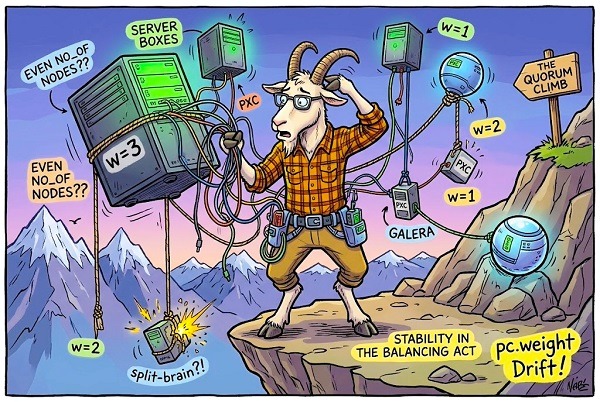
However, in Galera, we also have the setting wsrep_provider_options=”pc.weight=N”. With it, we can define a specific weight in the quorum calculation for each node. The question naturally arises: if we can assign a different weight to each node, why can’t we have an even number of nodes and assign them different weights?
The answer to the question is simple, yes, we can.
What is not simple is to identify who should have a different weight and how to distribute it.
To understand the problem, we need to review how the quorum is calculated (I have touched on the topic long ago here TusaCentral – Geographic replication and quorum Calculation in MySQL/Galera) and what a View is.
In Percona XtraDB Cluster (PXC) and Galera, a View (or cluster view) is the agreed-upon membership of the cluster at any specific moment in time. It represents the exact list of nodes that are currently connected, synchronized, and actively communicating with each other.
Whenever a node joins the cluster, leaves gracefully, or drops out due to a network failure, the remaining connected nodes negotiate a new View and assign it a unique View ID.
Its relationship to the Primary Component (PC) is based on quorum:
Essentially, a View defines who is currently connected to each other, while the Primary Component is the specific View that has enough members to safely keep the database running.
访问原文
返回搜索
https://www.percona.com/blog/just-because-you-can-doesnt-mean-you-should-re-evaluating-galera-node-weights/
本页为82搜索生成的网页快照,内容来自站内索引;演示数据的原文链接仅作示例。