网页
综合
更新时间 2026-11-14 15:56:55
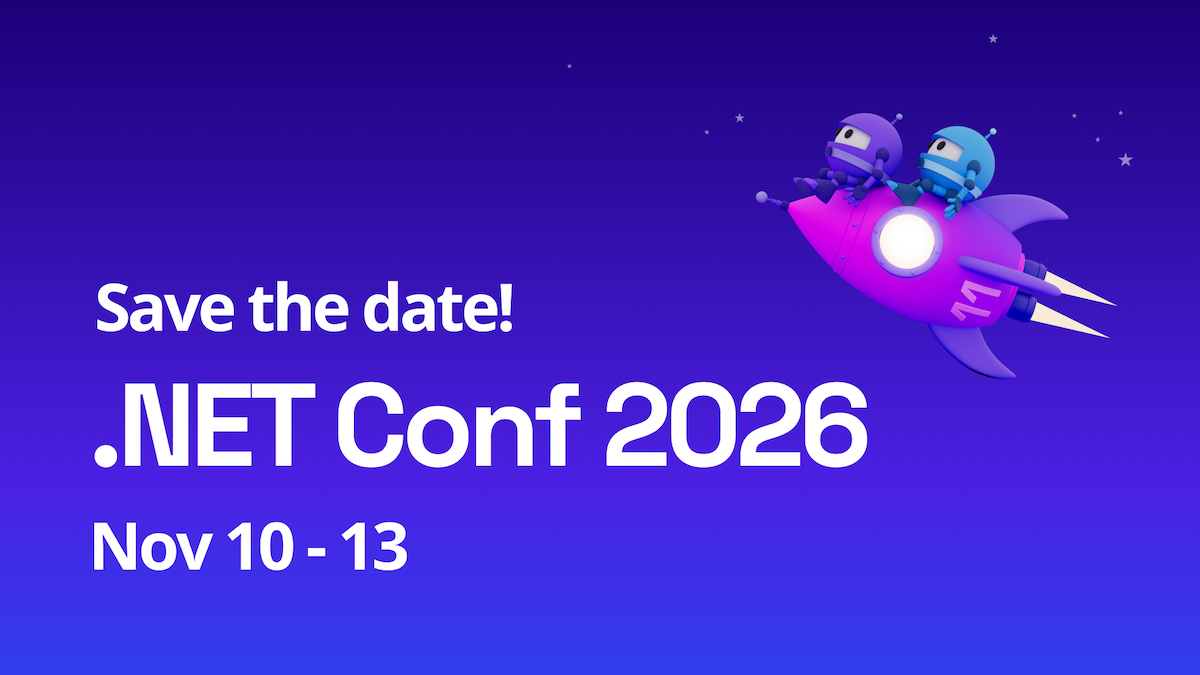
.NET Conf 2026
This site uses cookies for analytics and personalized content. By continuing to browse this site, you agree to this use.
Scott Hanselman Damian Edwards
Software development has never stood still. From Windows to the web, from building across platforms to the cloud, every new era has opened up new possibilities. And through it all, .NET has evolved alongside you, helping you bring your code, your apps, and your ideas forward. Now, we're entering another defining moment. AI is changing not just what we build, but how we build it, opening up new ways to create, understand, modernize and operate applications. Join Scott Hanselman and the .NET team as we explore what's new in .NET 11, see how .NET is evolving for the applications you have and the ones you'll build next, and discover how Copilot and agents are shaping the next era of development. What's next isn't about starting over. It's about how far you can go from here.
Mads Torgersen Dustin Campbell
Union types are coming to C#! Unions model closed sets of data shapes, as commonly seen in e.g. wire protocols. Mads and Dustin explore the clean expression of intent and the confidence and elegance that unions lend to consuming code. We'll also take a look at other upcoming C# features, such as closed classes and extension indexers.
Modern web development with ASP.NET Core & Blazor in .NET 11
ASP.NET Core and Blazor in .NET 11 deliver improvements across the web stack, driven by developer feedback and the demands of large-scale production services. In this demo-packed tour, we’ll see how .NET 11 strengthens the platform fundamentals with advances in performance, security, and observability; increases productivity across Minimal APIs, SignalR, and Blazor; and makes it easier to build distributed and agentic web applications. We’ll explore highlights including asynchronous validation, richer API contracts, more capable server-side rendering, scalable Blazor apps, deeper Aspire integration, and new building blocks for agentic user interfaces. Whether you build APIs, interactive web applications, or AI-enabled experiences, you’ll leave knowing how .NET 11 helps you build faster, more reliable, and more ambitious web applications.
Moving `dotnet` Ahead (of Time)!
In .NET 11, the `dotnet` CLI is a native app - it's snappy, responsive, and flexible! It took a lot of work to get there, and we learned about some 'gotchas' along the way, so we want to show you our process so that you can make excellent NAOT apps too!
Why WinForms must not change - yet reinvented itself with .NET 11!
Some of the world's most important line-of-business applications are built on WinForms. They contain decades of domain knowledge, countless customer-specific workflows, and—in many cases—millions of lines of proven code. Rewriting them is rarely economical, and breaking their behavioral or designer compatibility is simply not an option. That is why WinForms must not change. But standing still would be just as dangerous. To remain the best platform for evolving these applications, WinForms must also reinvent itself as the migration tool that lets teams modernize without discarding their investment. In .NET 11, that reinvention becomes visible. A new opt-in visual-styles generation gives controls modern metrics and appearance while preserving compatibility by default. Toggle switches, flash-reduced form startup, live Windows visual and accessibility settings, improved focus and text-scale handling, smoother batched UI updates, and new presentation capabilities help applications adopt today's Windows design language and accessibility expectations. The key is not to impose a disruptive new UI model, but to create deliberate conceptual seams inside existing applications: separating generated designer state from application logic, fixed layouts from adaptive layouts, synchronous UI mutation from responsive workflows, and irreplaceable business rules from replaceable presentation and infrastructure. AI makes those seams actionable at a scale that manual modernization could never reach. The designer and runtime must give AI-supported development enough structure to understand a form, preserve its intent, and transform it safely. At the same time, WinForms applications need modern runtime foundations through which developers can add domain-specific copilots, intelligent workflows, and local or connected AI services without rebuilding the entire product. This session explores how .NET 11 turns compatibility from a constraint into a modernization strategy—and how WinForms can preserve decades of customer value while helping business applications become more adaptive, accessible, performant, and ready for the AI era.
The .NET AI Stack: What's New, What's Next, and How It Fits Together
.NET developers have more AI building blocks than ever: model abstractions, data and retrieval, tools, agents, local inference, and the infrastructure that connects them. But how do these pieces fit together, and which ones should you reach for first? In this session, we'll take a practical look at the evolving .NET AI stack: what's available today, the patterns emerging across the ecosystem, and where things may be heading next. Through a combination of examples and demos, we'll explore how the pieces can be composed into useful applications. Whether you're just getting started or already building AI-powered software, you'll leave with a clearer mental model for navigating the .NET AI ecosystem and building what comes next.
What's New in .NET MAUI in .NET 11
.NET MAUI in .NET 11 continues to improve the experience of building production-quality mobile and desktop applications from a single codebase. In this session, we’ll explore the latest improvements, including the move to CoreCLR, XAML source generation enabled by default, C# expressions in XAML, XAML Incremental Hot Reload, and Material 3 styling on Android. We’ll also look at improvements to testing and the developer workflow, including how AI-ass
本页为82搜索生成的网页快照,内容来自站内索引;演示数据的原文链接仅作示例。