网页
综合
更新时间 2026-11-14 15:50:42
Agentis Lux
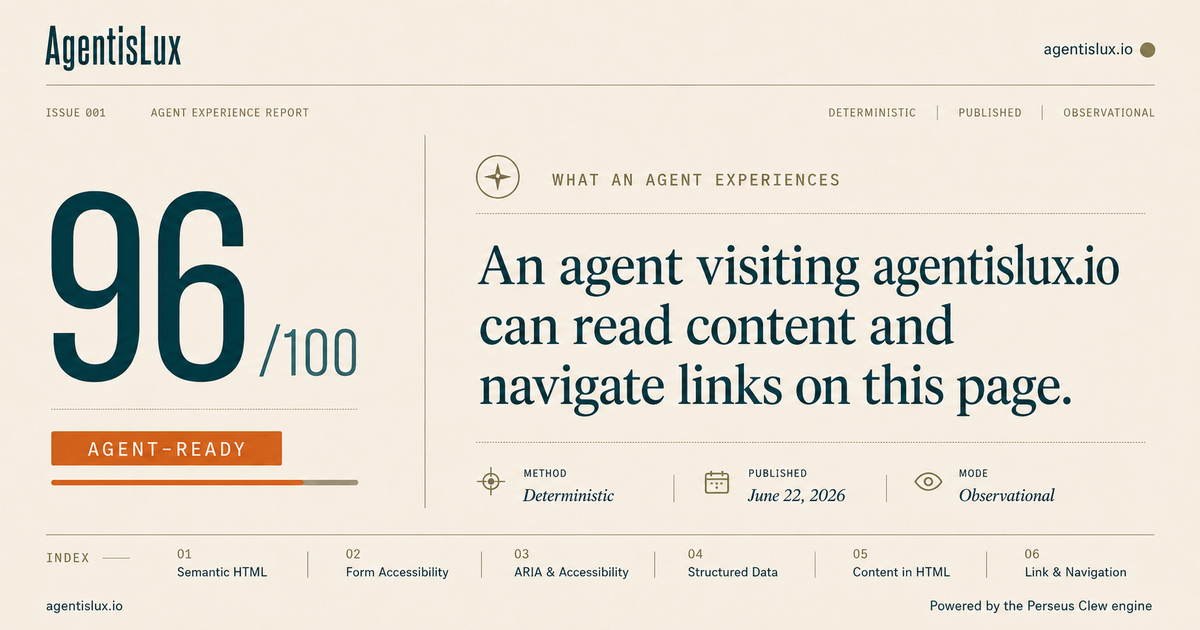
Your site has a new audience: AI agents. When someone asks ChatGPT or Perplexity a question, a retrieval agent pulls up your page and often reads the raw or minimally rendered HTML to answer them, rather than the visual version you see. Agentis Lux shows you what that agent can and can't read.
Frontend scanning live. Repo and API scanning on the Team tier.
Available on the Team tier.
Available on the Team tier.
No account · No tracking · ~10s scan
The Thesis · In Plain View
The internet was built for human eyes. Websites use visual layouts, styled divs, and JavaScript-rendered content that humans navigate by sight. Agents don't have eyes. They parse the DOM. When a button is a styled div instead of a button element, an agent cannot find it.
This is not a future problem. Retrieval agents read the web right now. ChatGPT visits URLs. Perplexity reads pages. Google's AI Overviews pull from live sites. They arrive by the million, read your HTML, and form an impression of your page, often without ever running your JavaScript. These retrieval agents are the second audience: a different reader than the human you designed for.
Agentis Lux scans your site and reports what an agent experiences. Six categories of deterministic checks. Findings written from the agent's perspective. No fixes suggested, because suggesting fixes implies we know your codebase, your constraints, and your reasons. We don't. We know what an agent sees.
On accessibility: there's real overlap with WCAG. Semantic HTML, proper labels, ARIA roles, heading hierarchy, structured data: these help screen readers and agents alike. Building for accessibility moves you toward agent-readiness. But agents are their own audience with their own needs, not a subset of the accessibility audience. The overlap is a baseline, not the whole story.
Whether interactive elements use semantic tags instead of styled divs. Agents identify elements by tag name. A div is not a button.
Whether inputs have labels, validation signals, and structure. A placeholder is not a label. Agents need to know what each field expects.
Whether dynamic widgets have correct roles and states. Agents use ARIA like screen readers do. Dynamic components need help.
Whether the page declares what it is. JSON-LD, microdata, schema markup. Agents use this to know a page without parsing visual layout.
Whether content is in the initial HTML or waiting for JavaScript. Many agents do not execute JS. A page that relies entirely on client-side JavaScript is often invisible to these readers.
Whether links have href attributes and descriptive text. Agents traverse a site through links the way they would read a sitemap.
“An agent visiting perseus-clew.vercel.app can read page content and interact with styled elements, but cannot follow 10 placeholder links or identify page type from missing structured data.”
No JSON-LD structured data is present. Agents cannot identify page type.
10 anchors use placeholder hrefs like '#'. Agents arrive at no destination.
“An agent visiting perseus-clew.vercel.app can read text and follow links, but cannot identify repeated sibling elements as lists without ul or ol wrappers.”
WebApplication JSON-LD structured data schema added.
Mapped all placeholder anchors to real, traversable URL destinations.
A scanner that tells you what AI agents experience when they try to use your product. Findings only. Methodology published. Not your gramma's SaaS.
本页为82搜索生成的网页快照,内容来自站内索引;演示数据的原文链接仅作示例。