网页
综合
更新时间 2026-11-14 10:02:07
Battery simulation software for R&D teams
The battery data and simulation layer
Ionworks turns your test data into validated physics-based models, so your team answers design questions before the next build. Built by the creators of PyBaMM.
A DFN model, parameterized from a few baseline 1 Ah pouch cells, searched electrode loadings and press densities for an eVTOL mission profile. Avrion Battery Labs built only the top candidates, and test data recalibrated the model after each build loop.
Savings are modeled, not measured: ten programs a year, three design parameters per program, and two build rounds saved per program.
Ionworks was founded by the creators and maintainers of PyBaMM, the open-source battery modeling package used across academic and industrial R&D.
Ionworks Studio brings that electrochemical depth into the lab. Operate runs the work around each test, and Simulate turns your team's test data into validated models, design sweeps, and engineering decisions you can defend.
Battery R&D teams need software that understands the structure of battery data, protocols, and models across the whole loop, from planning a test to deciding what to build next. Not a generic simulation platform that promises speed and optimization in the abstract.
Results live across shared drives, email, and vendor-specific file formats. Nobody is sure which file is current or which cycler produced it.
Every measurement is normalized, linked to its cell spec and experimental context, and searchable. Ionworks reads Maccor, Neware, Novonix, Arbin, BioLogic, and BasyTec natively. The data layer stands alone or feeds parameterization and simulation.
With thousands of protocols and no easy way to compare them, engineers rewrite tests from scratch. Then every new cycler or firmware update brings another custom parser, and it takes days to export and format the data after a test finishes.
Describe the test you need in plain English and the closest protocols in your library surface instantly. Every hardware generation is normalized on arrival, so your pipelines do not break when firmware changes.
A DFN or SPMe model is only as useful as its parameters. Connecting data to model, fitting, and validating is manual and error-prone.
A model, a validated parameter set, and a cell spec combined into one reusable object. The unit of work that makes simulations reproducible.
A fast-charge study can tie up cycler channels for weeks. Simulation answers the same question in minutes.
Charge at 1C to 4.2V, rest 10 minutes, discharge at C/3. Simulation accepts the protocol formats your team already uses: saved, typed, or uploaded from a cycler file.
Running a simulation in a notebook is straightforward. Turning it into a repeatable, traceable workflow across a mixed-skill team is a different problem entirely.
When a colleague runs the same parameterized model against the same protocol, the result matches. Immutable models and simulation reuse remove the guesswork about inputs.
Every turn runs through the same five steps, and the answer from the last one sets up the next. Operate makes each turn shorter by taking the waiting out of the work around the test. Simulate means you need fewer of them, by answering design questions before anything is built. Both run in Ionworks Studio.
Start from the tests you already have. Describe what you need in plain English and the closest protocols in your library surface instantly, so nobody rewrites one from scratch. Each protocol is simulated before it runs, estimating duration and catching step and limit faults before a channel is occupied.
Live sync from the cyclers you already run. Every Maccor, Neware, Arbin, and BioLogic file is normalized as it lands, with no parsers to maintain, and each measurement stays linked to its cell and protocol. Metrics sync back to your LIMS.
Fit physics-based models to your experimental data. Select a model type, define the parameters to estimate, and generate a parameterized model your team can trust across studies. Every cell you've ever tested becomes an asset your whole team can use.
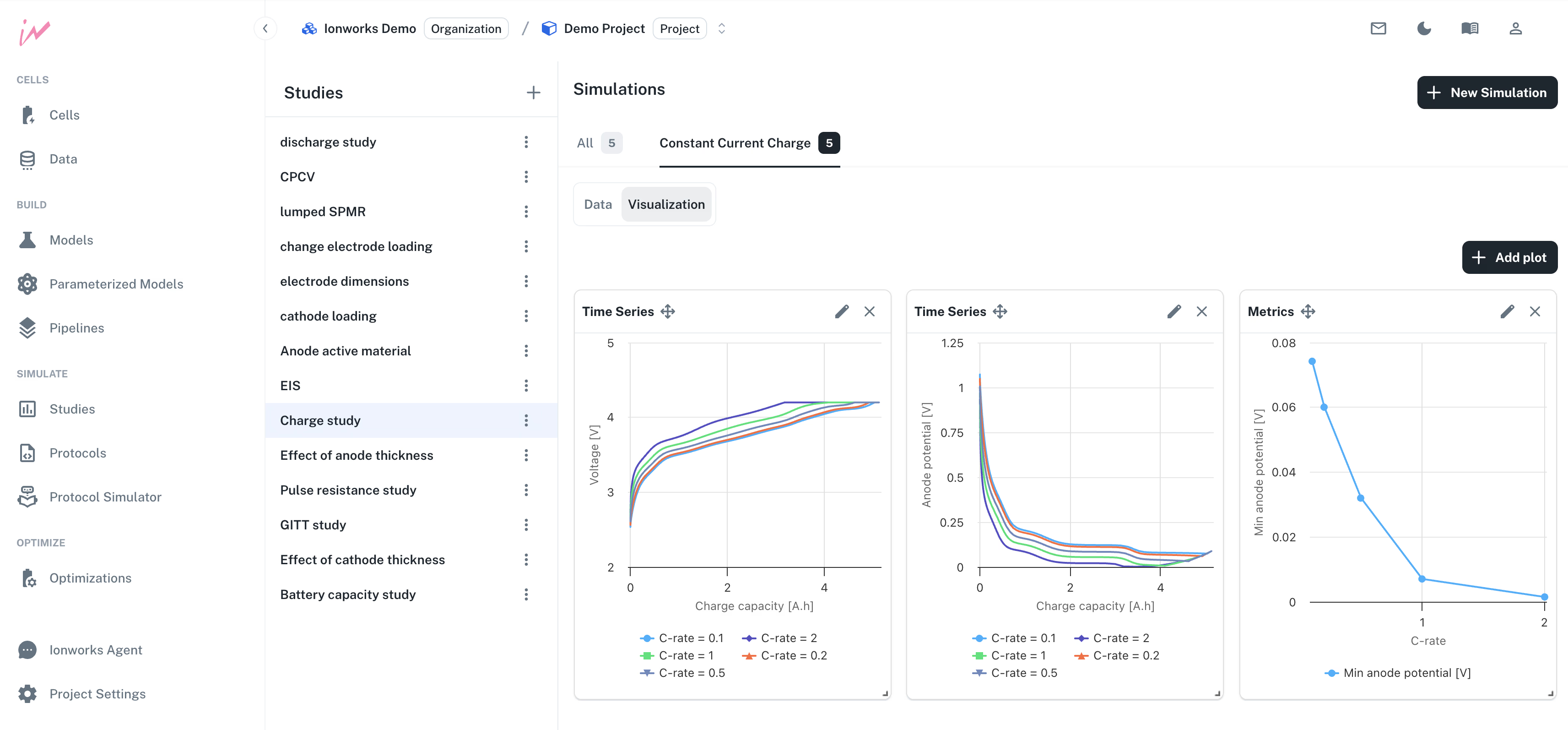
Run protocol simulations against parameterized models before committing cycler time. Evaluate fast-charge strategies, assess lithium plating risk, or compare internal states across cell designs, at simulation speed, not cycler speed.
Define engineering targets and search for the best design or protocol. Vary electrode thickness, porosity, loading, or charging strategy while managing degradation and plating constraints. Explore the design space without building more cells.
And the next turn starts here
Shorter turns, and fewer of them. When simulation answers a design question, that question never needs a build.
Everything in Ionworks Studio is available through the REST API and Python SDK. The same programmatic surface is what makes Ionworks work for AI agents — an automated system operates the platform through the same interface a human engineer uses. No separate "AI mode." The API was there first.
Every battery team hits the same wall eventually: physical testing can’t keep up with the questions their programs need answered. Simulation closes the gap, and looks different depending on the product.
Catch battery risk before tooling locks
Cell issues found in physical validation arrive after supplier contracts and production timelines have locked around the wrong assumptions.
Cycler data feeds parameterized models for each candidate cell. Duty-cycle simulations run in parallel with the test plan, so design questions get answered in days.
Engineering decisions move earlier. Late-stage redesigns drop. Programs hit their gates.
Push past the bench-tested envelope
Real missions cover thermal, altitude, and load conditions no lab campaign can reproduce. Datasheets stop being useful at the boundaries.
Validated physics models extrapolate where data ends. Trade studies sweep range, safety, and lifetime against mission profiles in an afternoon, not a year of cycler time.
More usable flight time per cell. Defensible operating
本页为82搜索生成的网页快照,内容来自站内索引;演示数据的原文链接仅作示例。