网页
综合
更新时间 2026-11-09 00:00:00
We raised $240M to build the intelligence platform for hardware | Nominal
We use cookies. Read more about cookies in our privacy policy (opens in a new tab)
Keeps the site working and remembers these choices. Always on.
Tells us which pages are read and which links are used, so we can improve the site.
Measures our campaigns on other sites, such as LinkedIn and Google.
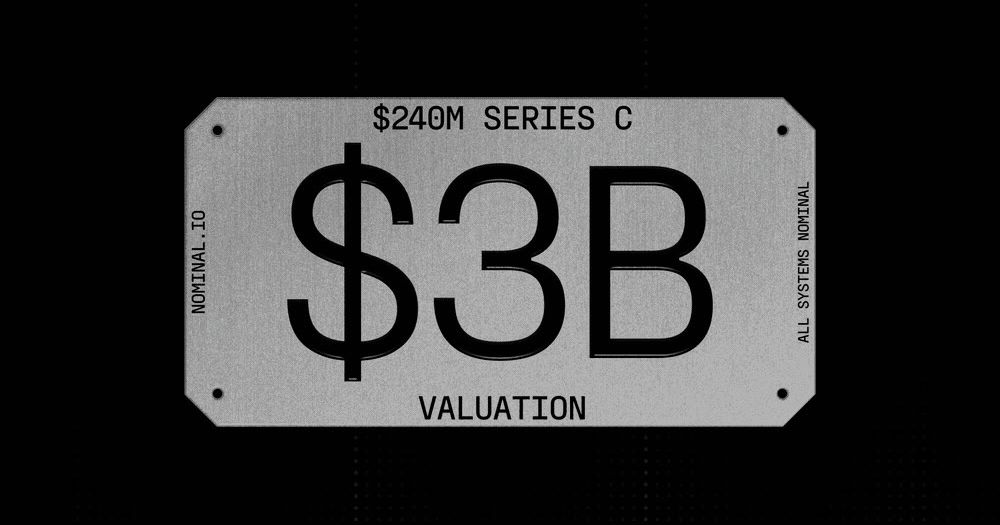
Nominal raised $240M at a $3B valuation, led by Lightspeed Venture Partners and co-led by Insight Partners, to give the engineering teams building the world’s most advanced machines a platform they can build on.
Nominal·Nov 09, 2026
The next generation of machines will be built by engineers working with increasingly powerful intelligence. They’re designing aircraft that fly farther, robots that do more, energy systems that generate and store power more efficiently, and spacecraft that take us places we’ve never been.
That future is taking shape today inside some of the most ambitious engineering teams in the world. They will solve problems that are difficult to imagine today, using tools that are only beginning to emerge.
But getting there will take more than better AI models. It will take a new foundation for how hardware is designed, built, tested, and improved.
We believe hardware engineering needs its own intelligence platform. One created specifically for the complexity of the physical world, where intelligence can connect to real systems, draw on engineering knowledge, and help people make better decisions with greater confidence.
Today, we’re announcing a $240 million Series C at a $3B valuation. For four years, we’ve built the infrastructure, connections, and engineering context hardware teams need. This round turns that foundation into the intelligence platform engineers build on.
AI can make engineers dramatically more capable. But more capable models alone won’t produce better machines.
In engineering, physics gets a vote.
A design can look right on paper and still fail in the real world. Machines must be built, tested, and proven. Unexpected results must be investigated. Every conclusion must hold up against evidence.
Engineering also depends on context that rarely lives in one place. Data is scattered across instruments, files, simulations, internal tools, and teams. Understanding an unexpected result might require connecting a sensor reading to a hardware configuration, a previous experiment, or a decision someone made months earlier.
A general-purpose model cannot reliably bridge these gaps on its own. It needs access to the right data, the context around it, and tools that let it investigate rather than simply generate an answer. And the human engineers responsible for the outcome need to understand the evidence behind its conclusions.
Bringing intelligence to the physical world takes more than powerful models. It takes a foundation that connects intelligence to the systems, data, and context of engineering.
Nominal began with a specific problem: hardware teams needed better ways to work with test data and make decisions from it.
Testing is where plans and predictions meet physics. Engineers compare what they expected to happen with what actually happened, investigate the difference, and use what they learn to determine what comes next. Yet the software supporting this work has often left engineers stitching together disconnected systems, rebuilding analyses, and manually piecing together the evidence they need.
We set out to change that, and over the past four years, we’ve built software that understands the realities of hardware development: complex, high-volume data; diverse physical systems; demanding deployment and security requirements; and workflows where the details matter.
That work has given us more than a starting point for AI. It has helped us build the underlying infrastructure, connections, and engineering context that intelligence needs in order to actually be useful in the physical world.
And it has put us alongside the teams doing some of the hardest work in engineering. We’ve learned from the environments where their systems are developed, the problems they encounter, and the evidence they need to move forward.
The opportunity now is to build on that foundation and to help frontier organizations meet the AI moment.
This is an evolution of our original mission to help hardware teams build better machines, faster and with greater confidence. AI creates the opportunity to accelerate that mission and, as a result, accelerate the mission of the humans who build on Nominal.
Realizing that opportunity depends on the foundation we build beneath them.
A Hardware Intelligence Platform brings together the systems, data, intelligence, and applications that hardware engineering requires. At Nominal, we think about this foundation in four connected layers.
Each solves a distinct problem and, together, they make intelligence useful across the hardware lifecycle.
Intelligence needs a connection to the systems engineers are building.
Connected Control links Nominal to physical hardware and the systems used to operate and test it. It enables teams to command equipment, capture data where it is generated, and connect engineering decisions to real-world results.
This connection matters because the physical world is not static. Systems change, tests reveal new information, and decisions lead to the next experiment. A platform that can connect to those systems can help engineers learn from what happens, not just analyze it after the fact.
Hardware generates enormous amounts of data, but volume alone does not create understanding.
Engineers need to bring together signals, files, configurations, documents, and other evidence from different tools and environments. They need to know what a measurement represents, which system produced it, and how it relates to earlier work.
Nominal’s Data Infrastructure is built around these realities. It gives engineering data a common structure while preserving the details and context that make it meaningful. It also provides the foundation for teams a
本页为82搜索生成的网页快照,内容来自站内索引;演示数据的原文链接仅作示例。